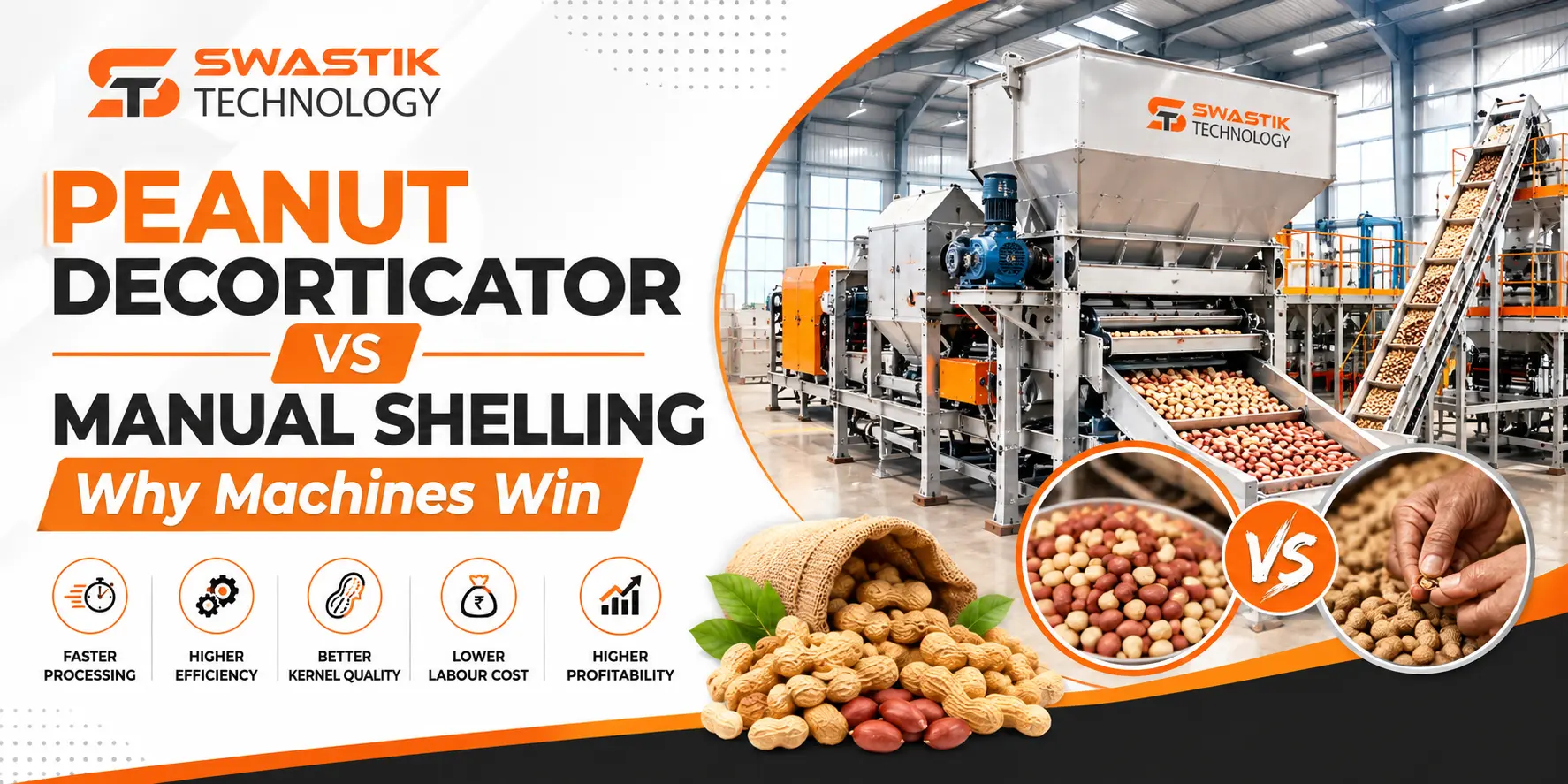

Every peanut processing business, whether a small farm operation or a large-scale export unit, eventually faces the same question: should peanuts be shelled by hand, or should the process be automated with a machine? The comparison of peanut decorticator vs manual shelling is one of the most important decisions a peanut processor can make, because it directly affects productivity, labor costs, product quality, and long-term profitability.
For decades, manual shelling was the only option available. Workers would sit for hours cracking shells by hand, separating kernels from husks one handful at a time. It worked, but it was slow, inconsistent, and physically exhausting. Today, the peanut decorticator has changed the game entirely, allowing processors to shell hundreds of kilograms of peanuts in the time it once took to shell a few kilograms manually.
In this blog, we will break down the real differences between a peanut decorticator and manual shelling, and explain exactly why automated machines are winning this comparison across the industry.
Manual peanut shelling is slow and labor-intensive, often taking hours to process even a small batch.
What Is Manual Peanut Shelling?
Manual shelling is the traditional method of removing peanut kernels from their outer shells using hands or simple hand tools. Workers press or twist each pod until the shell breaks, then pick out the kernel and discard the husk. This method has been used for generations in small farms and household-level operations where machinery was either unavailable or considered unnecessary for small quantities.While manual shelling requires no capital investment in equipment, it comes with serious limitations that become more obvious as the scale of operation grows.
What Is a Peanut Decorticator?
A peanut decorticator is a mechanical or motorized machine designed to separate peanut kernels from their shells automatically. The machine feeds raw peanut pods into a shelling chamber where rotating blades, rollers, or beating mechanisms crack the shells. A built-in sieving or air-blowing system then separates the clean kernels from the broken husks and debris.Modern decorticators, like the ones offered by Swastik Technology, are built for farms, processing units, and oil mills that need to shell large volumes of peanuts quickly and consistently, without relying on manual labor.
Peanut Decorticator vs Manual Shelling: Key Differences
1. Speed and Output Capacity
This is where the difference is most dramatic. A single worker manually shelling peanuts can typically process only a few kilograms per hour, depending on skill and fatigue levels. In contrast, a peanut decorticator can shell several hundred kilograms to a few tonnes per hour, depending on the machine’s capacity.For any business dealing with commercial quantities, the math is simple: what takes a team of ten workers an entire day to shell manually can often be completed by one machine operator in under an hour. This speed advantage alone makes automated shelling the clear winner for anyone processing peanuts beyond household quantities.
2. Labor Cost and Availability
Manual shelling requires a steady supply of workers, and during peak harvest season, labor becomes both expensive and hard to find. Wages add up quickly, especially when large volumes need to be processed within a limited timeframe before spoilage becomes a risk.A peanut decorticator machine reduces dependency on manual labor to just one or two operators who manage the machine, load raw pods, and collect the shelled kernels. Over time, this significantly lowers the operational cost per kilogram of peanuts processed, even after accounting for the machine’s initial price and maintenance.
A peanut decorticator machine processes hundreds of kilograms of peanuts per hour, reducing labor dependency significantly.
3. Consistency and Kernel Quality
Manual shelling is prone to human error. Workers may apply uneven pressure, accidentally crush kernels, or miss shells that need cracking. This inconsistency leads to a mixed-quality output with broken kernels, unshelled pods, and debris mixed in.A well-calibrated peanut decorticator delivers far more consistent results. The machine applies uniform pressure across all pods, resulting in a higher percentage of whole, undamaged kernels. Many machines also include adjustable settings to accommodate different peanut sizes and shell thicknesses, further improving output quality. For processors who sell peanuts by grade or export them, this consistency directly impacts pricing and marketability.
4. Hygiene and Contamination Control
When peanuts are shelled by hand, they come into direct contact with human skin, tools, and the surrounding environment, increasing the risk of contamination. This is a growing concern for food safety compliance, especially for businesses supplying to retail chains, food manufacturers, or export markets with strict hygiene standards.Automated decorticators minimize human contact with the product. Many machines are built with food-grade materials and enclosed shelling chambers, reducing exposure to dust, dirt, and external contaminants. This makes automated shelling a safer choice for businesses that need to meet quality certifications.
5. Physical Strain on Workers
Manual shelling is repetitive and physically demanding. Workers who shell peanuts for long hours often experience hand fatigue, joint pain, and reduced productivity over time. This is a real occupational hazard that businesses relying on manual labor must account for, both ethically and in terms of workforce turnover.By shifting the heavy, repetitive work to a machine, businesses reduce the physical burden on their workforce and can redirect labor to other value-added tasks like sorting, packaging, or quality inspection.
6. Scalability for Growing Businesses
One of the biggest advantages of investing in a peanut decorticator is scalability. As demand grows, a manual shelling operation has very limited room to scale, since the only way to shell more peanuts is to hire more workers, which increases costs proportionally.A machine-based operation, on the other hand, can scale output simply by running the decorticator for longer hours or investing in a higher-capacity model. This makes automated shelling a far more sustainable choice for businesses planning long-term growth in the peanut processing industry.
7. Return on Investment (ROI)
It’s true that a peanut decorticator requires an upfront investment that manual shelling does not. However, when you calculate the labor cost savings, the reduction in wasted or damaged kernels, and the increased processing capacity, most businesses recover the cost of the machine within a relatively short period.Over the machine’s operational lifespan, the savings in labor alone often far exceed the initial purchase price, making the decorticator a smart long-term investment rather than just an added expense.
When Does Manual Shelling Still Make Sense?
To be fair, manual shelling isn’t entirely obsolete. For very small-scale, household-level use, where only a few kilograms of peanuts need to be shelled occasionally, buying a machine may not be justified. In such cases, manual shelling remains a practical, low-cost option.However, for any business, farm, or processing unit dealing with peanuts on a commercial scale, the limitations of manual shelling quickly outweigh its low upfront cost. Time delays, labor dependency, inconsistent quality, and physical strain all add up to reduced profitability over time.
Why Businesses Are Switching to Automated Peanut Decorticators
Across the agricultural processing industry, the shift toward mechanization isn’t just a trend, it’s a response to real operational pressures. Rising labor costs, growing demand for consistent product quality, and increasing competition in domestic and export markets are pushing peanut processors to modernize their operations.A reliable peanut decorticator allows businesses to:
- Process significantly larger volumes in less time
- Reduce dependency on seasonal or unreliable manual labor
- Improve kernel quality and reduce breakage
- Meet hygiene and food safety expectations
- Scale operations without proportionally increasing costs
- Free up workers for higher-value tasks
These benefits compound over time, making automated shelling not just a convenience, but a competitive necessity for serious peanut processors.
Choosing the Right Peanut Decorticator for Your Business
Not all decorticators are built the same. When selecting a machine, consider factors like processing capacity (kilograms or tonnes per hour), power requirements, ease of maintenance, kernel breakage rate, and the availability of after-sales support and spare parts.Swastik Technology offers a range of groundnut decorticator machines designed for different scales of operation, from small processing units to large commercial setups. You can explore the available models and specifications here: Peanut Decorticator by Swastik Technology.
Peanuts shelled using an automated decorticator show consistent size, minimal breakage, and cleaner separation from husks.
Final Verdict: Peanut Decorticator vs Manual Shelling<
When comparing peanut decorticator vs manual shelling side by side, the advantages of automation are hard to ignore. Machines process peanuts faster, more consistently, and at a lower long-term cost than manual labor. While manual shelling may still hold a place in very small, occasional-use scenarios, any business aiming for growth, efficiency, and quality consistency needs to seriously consider switching to an automated peanut decorticator.The peanut processing industry is moving forward, and those who adopt the right machinery early will be better positioned to meet rising demand, control costs, and deliver a superior product to their customers.
If you’re ready to move beyond manual shelling and explore automated solutions built for your production needs, get in touch with Swastik Technology to find the right peanut decorticator for your business.