
Grading is one of the most important steps in groundnut processing, yet it’s also one of the most overlooked when businesses are setting up or upgrading their production line. Many processors focus heavily on shelling and cleaning equipment, only to realize later that inconsistent grading is costing them money through lower prices, rejected batches, or unhappy buyers. If you’re wondering how to choose a groundnut grader machine for your plant, this guide will walk you through everything you need to know before making a decision.
A peanut grading machine separates groundnut kernels or pods by size, ensuring that every batch leaving your facility meets a consistent standard. Whether you’re supplying to oil mills, export markets, or packaged snack manufacturers, the size and uniformity of your groundnuts directly affects the price you can command and the trust you build with buyers. Choosing the wrong grader, or skipping this step altogether, can undo all the efficiency gains you made earlier in the production process.
Let’s break down what a groundnut grader does, the different types available, and exactly how to choose the right one for your specific operation.
Why Grading Matters in Groundnut Processing
Before diving into machine selection, it’s worth understanding why grading is non-negotiable in a modern processing plant.
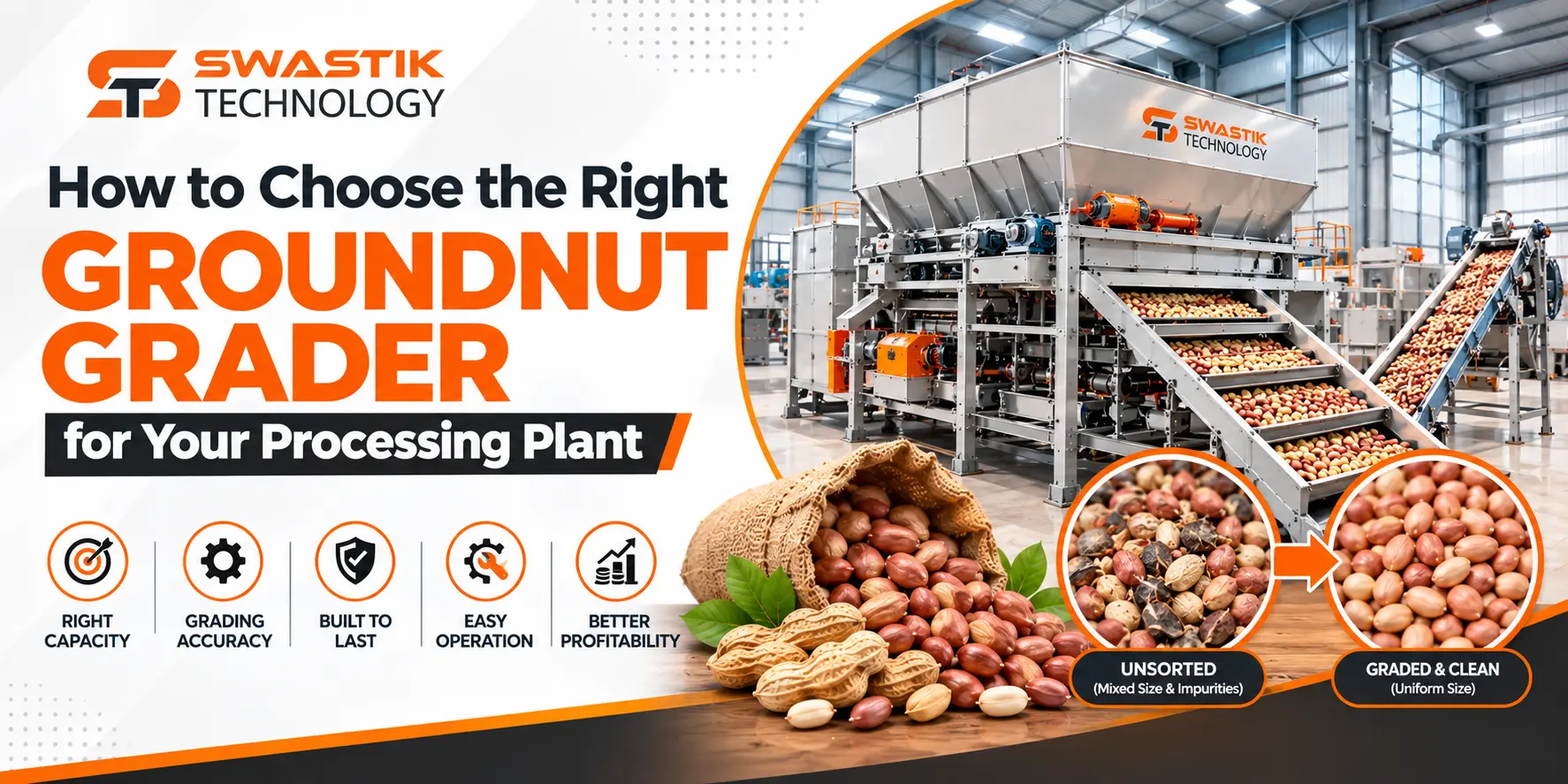
Ungraded groundnuts, mixed in size and shape, are harder to price fairly and harder to sell to premium buyers. Export markets and large-scale food manufacturers almost always specify a required size range, and failing to meet that specification can mean rejected shipments or discounted pricing. On top of that, uniform-sized kernels roast, cook, and package more evenly, which matters a great deal to snack food producers and oil extraction units alike.
A reliable grading machine solves this problem at scale, replacing slow and inconsistent manual sorting with a fast, repeatable mechanical process.
Types of Groundnut Graders
Not every grader works the same way, and understanding the differences is the first step toward choosing correctly. Based on function and design, groundnut and peanut graders generally fall into the following categories:1. Grader / Screen Grader
A screen grader, sometimes simply called a grader, uses a series of perforated screens or sieves with different hole sizes to separate groundnuts by size. As the material moves across the screens, smaller kernels or pods fall through the finer mesh while larger ones continue along the surface and drop through the appropriate larger openings further down the line. Screen graders are valued for their simplicity, durability, and ability to handle high volumes with minimal moving parts, making them a common choice for both pods and shelled kernels.
2. Grading Grader
The grading grader is a more advanced classification unit designed to sort produce into multiple defined size or quality categories in a single pass. Rather than a simple two-way or three-way split, a grading grader typically uses a combination of screens, adjustable gaps, or graded openings arranged in sequence to produce several distinct output grades at once. This type is particularly useful for processors who need to segment their output into more than just “large” and “small,” such as facilities supplying different grades to different buyers simultaneously.
3. Round Grader
The round grader, also known as a rotary or drum grader, uses a rotating cylindrical drum fitted with perforations of increasing size along its length. As groundnuts tumble through the rotating drum, smaller kernels fall through the smaller perforations near the entry point, while larger kernels travel further down the drum before falling through larger openings. Round graders are especially popular for their continuous, gentle sorting action, which minimizes kernel damage while maintaining high throughput. They are widely used in facilities that prioritize both speed and product integrity, making the Round Grader one of the most preferred choices for medium to large groundnut processing operations.
How to Choose Groundnut Grader Machine: Key Factors to Consider
Now that you understand the main types, here’s exactly how to choose the groundnut grader machine that fits your plant’s needs.1. Understand Your Output Requirements
Start by identifying how many size grades your buyers actually require. If your market simply wants “large” and “small” groundnuts separated, a basic screen grader may be sufficient. But if you’re supplying multiple buyers with different specifications, for example, one batch for export and another for local oil milling, a grading grader capable of producing multiple output streams in one pass will save you significant time and reduce handling.
2. Consider Your Processing Volume
Capacity is one of the biggest deciding factors. Small or seasonal operations may do fine with a compact grader that processes a few hundred kilograms per hour. Larger commercial plants handling several tonnes per day need a machine, often a Round Grader, built for continuous high-volume operation without frequent downtime for cleaning or screen changes.
3. Prioritize Kernel Integrity
Some grading methods are gentler on the product than others. If you’re processing groundnuts for direct human consumption or export, where whole, undamaged kernels command a premium price, a Round Grader’s tumbling drum action tends to cause less breakage compared to more aggressive vibrating screen setups. For oil extraction operations, where slight kernel damage is less of a concern, a standard screen grader may be a more cost-effective choice.
4. Check Adjustability and Flexibility
Buyer requirements change over time, and your grading machine should be able to adapt. Look for models with adjustable screen sizes, interchangeable drums, or configurable gaps so you can shift between size specifications without purchasing an entirely new machine. This flexibility is particularly valuable for processors who serve multiple markets or export destinations with varying size standards.
5. Evaluate Build Quality and Maintenance
Grading machines run for long hours during peak season, so build quality matters. Look for sturdy frames, quality bearings, and easily replaceable screens or perforated components. Ask about the availability of spare parts and after-sales support before committing to a supplier, since downtime during harvest season can be costly.
6. Factor in Power Requirements and Space
Larger graders, especially rotary drum types, require adequate floor space and consistent power supply. Before selecting a machine, map out your available plant layout and confirm the electrical load your facility can support. This avoids costly last-minute infrastructure changes after the machine has already been purchased.
7. Compare Cost Against Long-Term Value
While upfront price matters, it shouldn’t be the only deciding factor. A cheaper machine that damages kernels, requires frequent repairs, or can’t keep up with your volume will cost more in the long run through lost quality premiums and downtime. Calculate the cost per tonne processed over the machine’s expected lifespan, rather than just comparing sticker prices.
Screen Grader vs Grading Grader vs Round Grader: Which One Is Right for You?
If your operation is small to mid-sized and you only need a basic size separation, a Screen Grader offers a simple, budget-friendly, and durable solution.
If you need to produce multiple size grades simultaneously to serve different buyers or product lines, a Grading Grader offers the flexibility and precision needed for complex sorting requirements.
If your priority is high throughput combined with minimal kernel damage, particularly for export-quality or premium consumption-grade groundnuts, the Round Grader is generally the preferred choice among processors who need both speed and product integrity at scale.
Many larger processing plants actually use a combination of these machines in sequence, first passing groundnuts through a screen or round grader for primary size separation, then using a grading grader downstream for finer classification. The right setup ultimately depends on your product mix, buyer requirements, and production volume.
Final Thoughts
Choosing the right groundnut grader isn’t just a matter of picking whichever machine is cheapest or most readily available. It requires a clear understanding of your buyer requirements, production volume, and the trade-offs between speed, cost, and kernel quality across the different grader types available, including the Screen Grader, Grading Grader, and Round Grader.Investing time upfront to match the right peanut grading machine to your specific operation pays off through better product quality, stronger buyer relationships, and improved margins over time. As demand for consistently graded groundnuts continues to grow across export and food processing markets, having the right grading equipment in place isn’t just an operational upgrade, it’s a competitive advantage.
If you’re setting up a new groundnut processing line or upgrading your existing grading system, take the time to evaluate your specific volume, product goals, and buyer specifications before making your final choice. The right grader will pay for itself many times over through consistent quality and reduced waste.