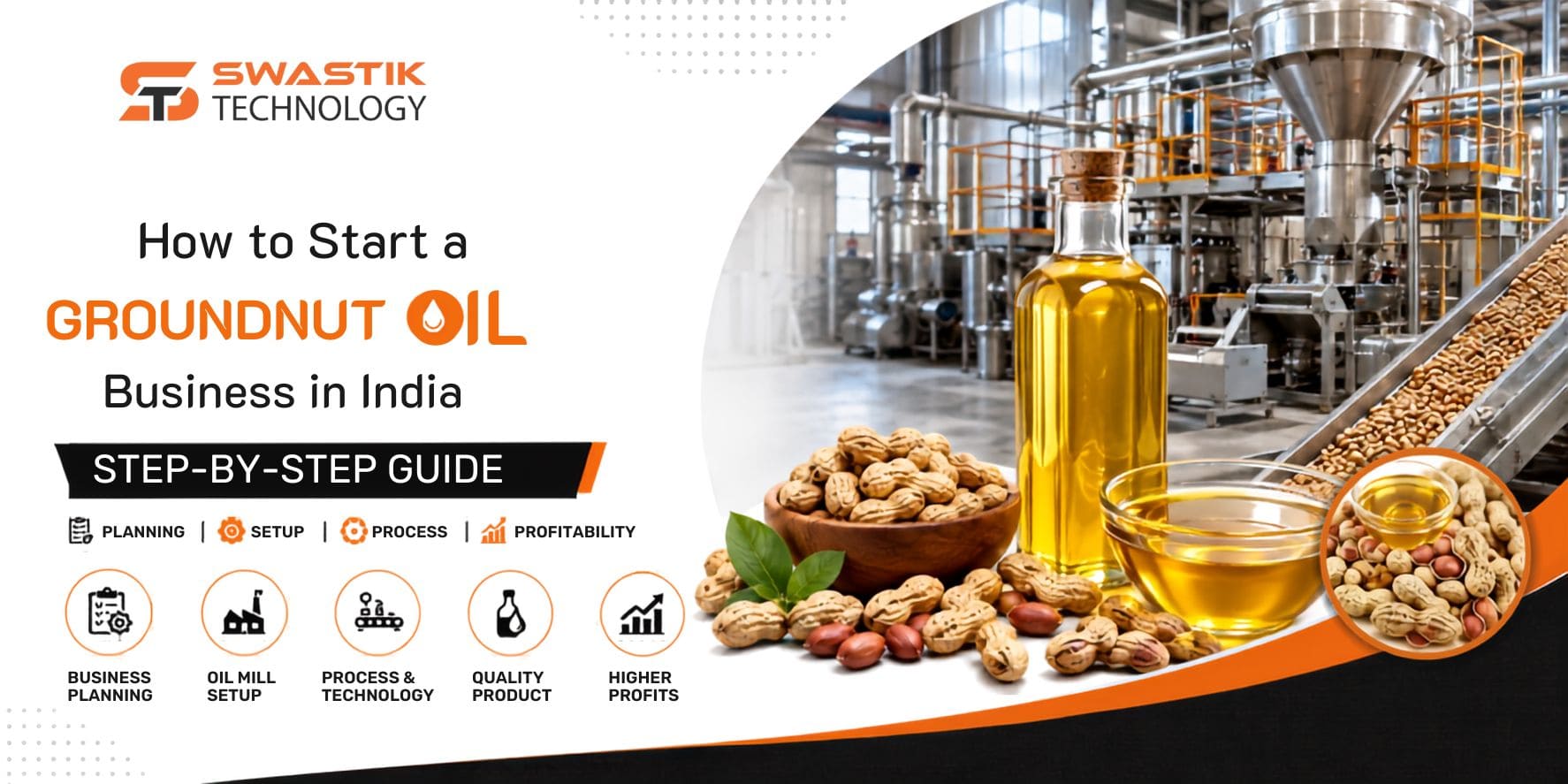

Starting a groundnut oil business in India may sound like a simple or even “boring” business but simple businesses can make serious money when done right. Gulab, Vishwas, Fortune, and Dhara are good examples of brands that have built a strong presence in the edible-oil market.
India has strong groundnut production and steady demand for edible oils, making groundnut oil a promising opportunity. You can create value by turning raw groundnuts into groundnut oil, oil cake, and other marketable products.
But starting a groundnut oil business is more than buying an oil expeller. You need to choose your product, source quality groundnuts, select the right oil mill machinery and capacity, plan your investment, and identify your customers.
This guide covers the key steps to start a groundnut oil business in India, based on our experience designing mini oil mill plants for entrepreneurs and processors across the country.
Why Start a Groundnut Oil Business in India?
Before investing in machinery, it is important to understand the actual business opportunity.
1. Availability of Groundnuts in India
Groundnuts are widely cultivated across India, with major production coming from states such as Gujarat, Rajasthan, Andhra Pradesh, Tamil Nadu, Karnataka, and Maharashtra.
This provides oil manufacturers with access to locally produced raw material.
However, availability alone does not guarantee profitability. The location of the plant, procurement network, quality of groundnuts, seasonal price fluctuations, and transportation costs all affect the economics of the business.
2. Value Addition to Groundnuts
Selling raw groundnuts is one part of the agricultural value chain. Processing them can create additional value.
A groundnut processing business can potentially produce groundnut oil, groundnut oil cake, groundnut flour, roasted groundnuts, and other value-added groundnut products.
This gives businesses the opportunity to generate revenue from both the primary product and suitable by-products.
3. Established Demand for Groundnut Oil
Groundnut oil is a traditional cooking oil in many parts of India and is used by households, restaurants, food businesses, and manufacturers.
A groundnut oil manufacturer can target retail customers, wholesalers, distributors, restaurants, food manufacturers, institutional buyers, and direct-to-consumer sales.
The right target market should be identified before deciding the plant capacity and packaging strategy.
4. Different Business Models Are Possible
There is no single groundnut oil business model.
Depending on investment, target customers, and product positioning, an entrepreneur may consider filtered groundnut oil, expeller-pressed groundnut oil, cold-pressed groundnut oil, refined groundnut oil, bulk groundnut oil, or packaged consumer groundnut oil.
Each model can require different processing stages, equipment, quality-control procedures, investment levels, and marketing strategies.
5. Opportunity to Build a Brand
A groundnut oil business does not have to operate only as a commodity business.
A manufacturer can build a consumer brand around product quality, processing method, packaging, product consistency, source of groundnuts, brand positioning, and distribution.
This can create an opportunity to move from simply processing oil to building a long-term food business.
6. Additional Revenue From By-Products
Groundnut oil extraction produces oil cake as a major by-product.
Depending on its quality and intended application, groundnut oil cake can be sold into appropriate feed, agricultural, or industrial markets.
Therefore, when evaluating the business, consider the economics of the complete output, rather than looking only at the selling price of groundnut oil.
How to Set Up a Groundnut Oil Manufacturing Business in India
Step 1: Decide What Type of Groundnut Oil Business You Want to Start
This should be your first major decision.
Ask: What product am I going to sell, and who is going to buy it?
- Cold-Pressed Groundnut Oil — targets consumers looking for specialty or traditionally processed edible oils
- Filtered Groundnut Oil — oil extraction followed by filtration and packaging
- Expeller-Pressed Groundnut Oil — mechanical oil extraction for different commercial applications
- Refined Groundnut Oil — generally involves additional processing stages and infrastructure compared with basic extraction and filtration
- Bulk Groundnut Oil — supplying oil in bulk to commercial buyers instead of retail packaging
The plant should be designed around the selected business model.
Step 2: Identify Your Target Customers
Before investing in a plant, determine who will purchase the oil.
Potential customers include household consumers, retail stores, supermarkets, restaurants, hotels, food manufacturers, distributors, wholesalers, institutional buyers, and export customers.
Your target customers influence the product specification, packaging size, quality requirements, production volume, and sales strategy.
For example, a business selling directly to consumers may require a stronger focus on branding and retail packaging, while a bulk supplier may prioritize production capacity and cost efficiency.
Step 3: Study the Groundnut Market
A groundnut oil business depends heavily on the price and quality of raw groundnuts.
Before setting up the plant, study groundnut availability, local production, seasonal supply, prices, varieties, oil content, quality, transportation costs, storage requirements, and local competition.
The objective is to understand whether you can obtain enough suitable groundnuts at a commercially viable cost.
Step 4: Choose the Plant Location
Location can have a major impact on operating costs.
Consider proximity to groundnut-producing areas, access to transportation, reliable electricity, labour availability, storage facilities, and market access.
The best location is therefore not necessarily the place with the cheapest land. It is the location that provides a practical balance between raw material, utilities, labour, logistics, and market access.
Step 5: Decide the Production Capacity
One of the most important decisions is determining how much groundnut oil you want to produce.
Capacity should not be selected simply because a larger machine appears more attractive.
Consider available raw groundnuts, expected sales volume, target market, investment budget, factory space, working capital, operating hours, and future expansion plans.
For example, a small regional brand may require a very different capacity from a manufacturer supplying multiple states or export customers.
If you expect demand to grow, you can also consider a plant layout that allows future capacity expansion.
Step 6: Understand the Groundnut Oil Manufacturing Process
The exact process depends on the type of groundnut oil you want to manufacture.
A typical mechanical extraction process can involve:
Groundnut Receiving → Cleaning → Destoning → Decortication/Shelling → Grading → Crushing/Conditioning → Oil Extraction → Filtration → Storage → Packaging
Let’s look at the major stages.
1. Groundnut Receiving — Raw groundnuts are received at the factory and inspected for quality, moisture, foreign materials, and damage.
2. Cleaning — Removes unwanted materials such as dust, soil, stones, stalks, leaves, and other foreign materials, improving raw-material quality and protecting downstream machinery.
3. Destoning — A destoner separates heavy foreign materials such as stones from the groundnut stream.
4. Shelling or Decortication — Depending on plant design, a decorticator removes the shells before further processing. The shelling system should be selected according to groundnut variety, capacity, and required kernel quality.
5. Grading — A grader separates groundnuts by size or other characteristics, creating a more consistent feed for subsequent stages.
6. Crushing or Conditioning — Prepared kernels may undergo crushing, conditioning, or related preparation before mechanical oil extraction.
7. Oil Extraction — An oil expeller or other suitable extraction system separates oil from the prepared groundnut material.
8. Filtration — Removes suspended particles and other impurities, producing a cleaner oil suitable for the next stage.
9. Storage — Processed oil is stored in suitable tanks or containers under appropriate conditions before packaging or bulk distribution.
10. Packaging — For retail sales, oil is filled into suitable containers and labelled according to applicable requirements.
Step 7: Select the Required Groundnut Oil Machinery
The machinery required depends on your production method and capacity.
A typical groundnut oil processing line may include a groundnut cleaner, destoner, decorticator, grader, crushers or preparation equipment, an oil expeller, oil filtration system, storage tanks, pumps, conveyors, weighing and filling equipment, and packaging machines. You can see the full range on our machinery page.
A larger or more integrated plant may require additional equipment for refining, automation, material handling, quality control, and packaging.
Do not select machinery first and then decide what business to build around it. Start with your product, market, capacity, and process. Then select the machinery.
Step 8: Calculate the Groundnut Requirement and Oil Yield
Before investing, estimate how much raw groundnut the plant will consume and how much oil it can produce.
Oil yield can vary depending on groundnut variety, kernel quality, moisture, oil content, shelling efficiency, processing conditions, extraction method, and equipment performance.
Therefore, avoid using a single theoretical yield as a guaranteed commercial output. A proper feasibility study should consider realistic operating conditions and expected processing losses.
You should calculate: Raw Groundnut Input → Processing Losses → Oil Output + Oil Cake Output
This provides a more realistic basis for calculating production economics.
Step 9: Estimate the Investment Required
There is no single fixed cost for starting a groundnut oil business in India.
The investment depends on plant capacity, processing method, automation, factory infrastructure, and product range.
Major cost components include:
- Machinery — the oil extraction system and supporting equipment
- Factory infrastructure — land, building, production area, storage, electrical infrastructure, water systems, ventilation, loading/unloading areas
- Installation — machinery installation, electrical work, piping, testing, commissioning
- Packaging — filling, capping, labelling, sealing equipment for retail businesses
- Storage — storage tanks, raw-material storage, finished-product storage, by-product storage
- Working capital — groundnut purchases, packaging materials, labour, electricity, transportation, maintenance, inventory, distribution, marketing
A common mistake is to spend most of the available capital on machinery and leave insufficient funds to operate the plant.
Want an estimate specific to your production capacity? Every plant we quote is sized to your actual raw material supply and target output — not a generic package. Request a Quote for Your Groundnut Oil Plant →
Step 10: Understand the Licenses and Regulations
Before commercial production, identify the applicable registrations, licenses, and food-safety requirements for your business.
Depending on the operation and products, requirements may involve business registration, FSSAI licensing, GST registration where applicable, food-safety requirements, product labelling requirements, packaging requirements, environmental requirements, local factory and labour requirements, and other applicable regulatory approvals.
Requirements can vary depending on the business structure, production process, location, and products. Always verify the current requirements with the relevant authorities before starting commercial production.
Step 11: Plan Packaging and Branding
If you are selling directly to consumers, packaging becomes an important part of the business.
Possible retail pack sizes can include different bottle or container sizes depending on your target market.
Your packaging strategy should consider product protection, food safety, shelf life, ease of handling, labelling, brand identity, retail presentation, and distribution requirements.
Your brand can also differentiate the product through its positioning, such as traditional processing, cold pressing, quality sourcing, or other legitimate product attributes.
Step 12: Calculate Groundnut Oil Business Profitability
A groundnut oil business can create value, but profitability should be calculated rather than assumed.
Your financial model should include:
Revenue: Groundnut Oil Revenue + Oil Cake/By-Product Revenue + Other Product Revenue
Costs: Groundnut purchase, electricity, labour, packaging, transportation, maintenance, rent or factory costs, financing costs, marketing, administrative expenses, taxes and applicable charges
Your profitability will depend on the relationship between raw-material cost, processing yield, operating expenses, and selling prices.
Instead of asking “How much profit does a groundnut oil mill make?”, ask:
“How much groundnut will I process, what realistic oil yield can I achieve, what will the raw material cost, what will the oil and by-products sell for, and what will it cost to operate the plant?”
This approach produces a much more realistic business estimate.
Step 13: Decide How You Will Sell the Oil
A good production plant still needs a strong sales strategy.
- Retail — grocery stores, supermarkets, local retailers, e-commerce, direct-to-consumer channels
- Wholesale — larger quantities to wholesalers and distributors
- Institutional — restaurants, hotels, caterers, food manufacturers, commercial kitchens
- Private label — manufacturing oil for another brand under a private-label arrangement, subject to applicable commercial and regulatory requirements
The best model depends on your production capacity and target customers.
Step 14: Plan for Groundnut Oil Cake
Do not overlook the by-product.
After oil extraction, the remaining groundnut cake can become an additional commercial output depending on its quality and intended use.
Before starting production, identify potential buyers, expected selling price, storage requirements, transportation, and quality specifications.
Including by-product revenue in your feasibility study can provide a more complete picture of the business.
Common Mistakes When Starting a Groundnut Oil Business
- Buying machinery before studying the market. A machine cannot create demand — understand your customers and product first.
- Choosing excessive capacity. A large plant with low utilization can increase fixed costs and working-capital pressure.
- Ignoring raw-material quality. Poor-quality groundnuts can affect oil quality and processing performance.
- Underestimating working capital. You need money to purchase raw material and operate the business after machinery is installed.
- Focusing only on oil revenue. Consider the value of suitable by-products such as groundnut cake.
- Ignoring packaging and distribution. A good product still needs to reach customers efficiently.
- Choosing a supplier only on machine price. The cheapest quotation may not represent the lowest total cost of ownership — consider machine quality, plant design, energy efficiency, installation, commissioning, training, spare parts, maintenance, technical support, and future expansion.
How to Choose a Groundnut Oil Plant Manufacturer
Choosing the right manufacturer is an important part of the project. Before placing an order, evaluate whether the manufacturer can provide:
- Complete plant design — understanding the complete process rather than supplying only an individual oil expeller
- Capacity-based engineering — equipment designed around your intended production capacity
- Product-specific configuration — matching filtered, cold-pressed, expeller-pressed, refined, bulk, or packaged groundnut oil requirements
- Installation and commissioning support for achieving expected plant performance
- Operator training so your team can run and maintain equipment safely and efficiently
- After-sales support — technical assistance, maintenance, troubleshooting, spare parts
- Future expansion — whether the plant can be expanded later as your business grows
At Swastik Technology, this is how we approach every project: 35+ years designing groundnut oil and peanut processing lines, 700+ processors supplied across India and globally, and full support from plant design through installation, commissioning, and after-sales service.
Talk to an engineer who has designed groundnut oil plants for entrepreneurs across India. Talk to Our Engineering Team →
Groundnut Oil Business Setup Checklist
Before investing, make sure you have answers to these questions:
- What type of groundnut oil will I manufacture?
- Who are my target customers?
- Where will I source groundnuts?
- What quantity of groundnuts can I procure?
- What production capacity do I need?
- Where should I locate the factory?
- What machinery is required?
- What is my total investment budget?
- How much working capital will I need?
- What oil yield can I realistically expect?
- What will I do with the groundnut cake?
- What licenses and approvals are required?
- How will I package the oil?
- How will I distribute the product?
- What is my expected production cost?
- What selling price can the market support?
- What is my break-even point?
- Can I expand the plant in the future?
- Who will install and support the machinery?
If these questions are answered before purchasing equipment, you can make a much more informed investment decision.
Frequently Asked Questions
How much does it cost to start a groundnut oil business in India? There is no fixed cost — it depends on plant capacity, processing method, automation level, and factory infrastructure. Machinery, installation, packaging, storage, and working capital all factor into total investment. Request a capacity-specific quote →
What machinery is needed for a groundnut oil mill? At minimum: a cleaner, destoner, decorticator for shelling, grader, an oil expeller, and a filtration system. Retail businesses also need filling and packaging equipment.
Is a groundnut oil business profitable in India? Profitability depends on raw-material cost, processing yield, by-product (oil cake) revenue, and operating expenses — not on machinery or selling price alone. A proper feasibility study specific to your capacity and market gives a realistic answer.
Cold-pressed vs. expeller-pressed groundnut oil — which should I choose? Cold-pressed oil typically targets a premium, health-conscious consumer segment and involves different processing stages than standard expeller-pressed oil. The right choice depends on your target customers and brand positioning, decided in Step 1.
Final Thoughts
Starting a groundnut oil business in India can provide an opportunity to participate in agricultural value addition by converting locally available groundnuts into edible oil and other commercial products.
But the success of the project depends on much more than the oil extraction machine.
You need to understand your raw-material supply, product type, target market, production capacity, plant location, machinery, investment, working capital, quality requirements, regulations, packaging, distribution, and profitability before starting the business.
The best approach is to design the processing plant around your actual business requirements rather than buying standard equipment without a clear production plan.
Looking to Set Up a Groundnut Oil Plant?
Swastik Technology has supplied mini oil mill plants and groundnut processing machinery to 700+ customers over 35+ years, and can help you evaluate the machinery and plant configuration required for your groundnut oil business.
If you are planning a groundnut oil manufacturing project, share your required capacity, product type, raw-material availability, and target market with our team. This allows the processing line and machinery to be evaluated according to your actual requirements.
Contact Swastik Technology → to discuss your groundnut oil processing project and plant requirements. Our team responds within 24 hours.