
Peanuts, also known as groundnuts, are much more versatile than they may appear. While roasted peanuts are one of the most familiar products, the same crop can be transformed into a wide range of food products, ingredients, edible oils, animal-feed products, and even useful non-food byproducts.
This makes peanuts an important raw material for both food manufacturers and agricultural businesses. Depending on the quality of the kernels and the intended market, peanuts can be roasted, blanched, ground, pressed, milled, or further processed into different finished products.
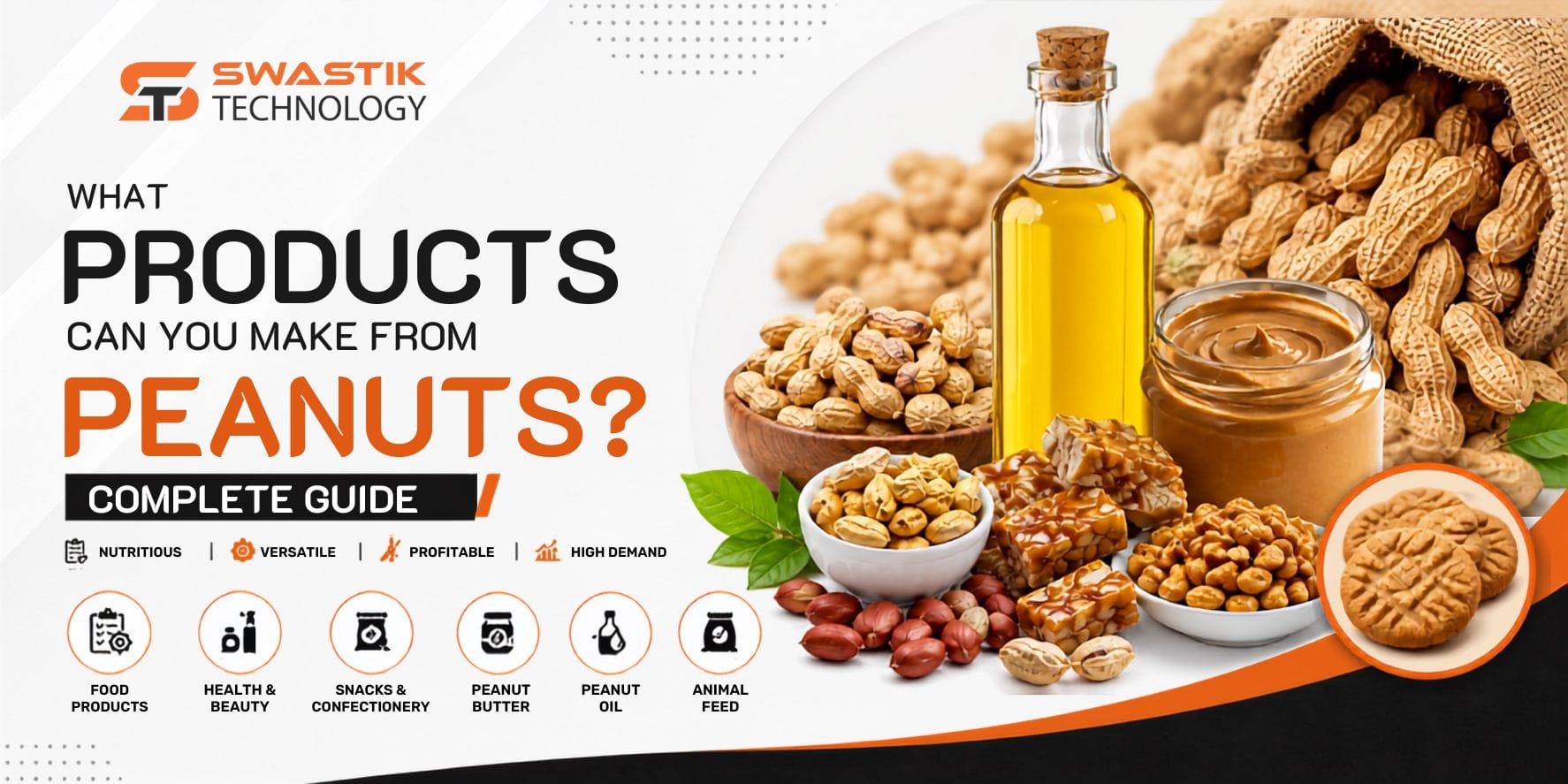
Some of the most common products made from peanuts include peanut oil, peanut butter, roasted peanuts, blanched peanuts, peanut flour, peanut snacks, confectionery products, peanut meal, and peanut cake.
In this guide, we’ll look at the major products that can be made from peanuts, how they are produced at a high level, and where each product is commonly used — plus the machinery Swastik Technology builds for each stage.
What Can You Make From Peanuts?
The main products made from peanuts can be broadly divided into four groups:
| Product Category | Examples |
| Whole Peanut Products | Roasted peanuts, salted peanuts, blanched peanuts |
| Peanut Ingredients | Peanut butter, peanut flour, peanut powder, peanut protein ingredients |
| Oil & Byproducts | Peanut oil, peanut cake, peanut meal |
| Value-Added Products | Peanut snacks, confectionery, peanut bars, sweets |
The important point is that the final product determines how the peanut kernels are processed. A peanut intended for roasting does not follow exactly the same route as one intended for oil extraction or peanut butter production.
1. Roasted Peanuts
Roasted peanuts are among the simplest and most widely recognized value-added peanut products.
After suitable cleaning, sorting, and preparation, peanut kernels are roasted under controlled conditions to develop their characteristic aroma, flavor, color, and texture. Depending on the market, they may then be salted, flavored, seasoned, or sold without additional seasoning.
Common roasted peanut products include:
- Dry-roasted peanuts
- Salted peanuts
- Unsalted roasted peanuts
- Masala or flavored peanuts
- Honey-coated or seasoned peanut products
- Roasted peanut kernels
Roasted peanuts are commonly sold as snacks or used as ingredients in other food products. For commercial production, consistent raw-material quality and controlled roasting are important because variations in kernel size and moisture can affect the final product.
2. Peanut Butter
Peanut butter is another major product made from peanuts.
The basic concept is straightforward: suitable peanut kernels are cleaned and prepared, roasted, cooled, and then ground into a smooth or coarse paste. Depending on the formulation, manufacturers may add ingredients such as salt, sugar, stabilizers, or other permitted ingredients.
The final texture can range from smooth and creamy to crunchy, depending on the manufacturing process and product formulation.
Peanut butter is used in:
- Bread and sandwiches
- Bakery products
- Protein foods
- Snacks
- Desserts
- Food-service applications
For manufacturers, peanut butter is particularly interesting because it converts a relatively simple agricultural commodity into a higher-value branded food product.
3. Peanut Oil
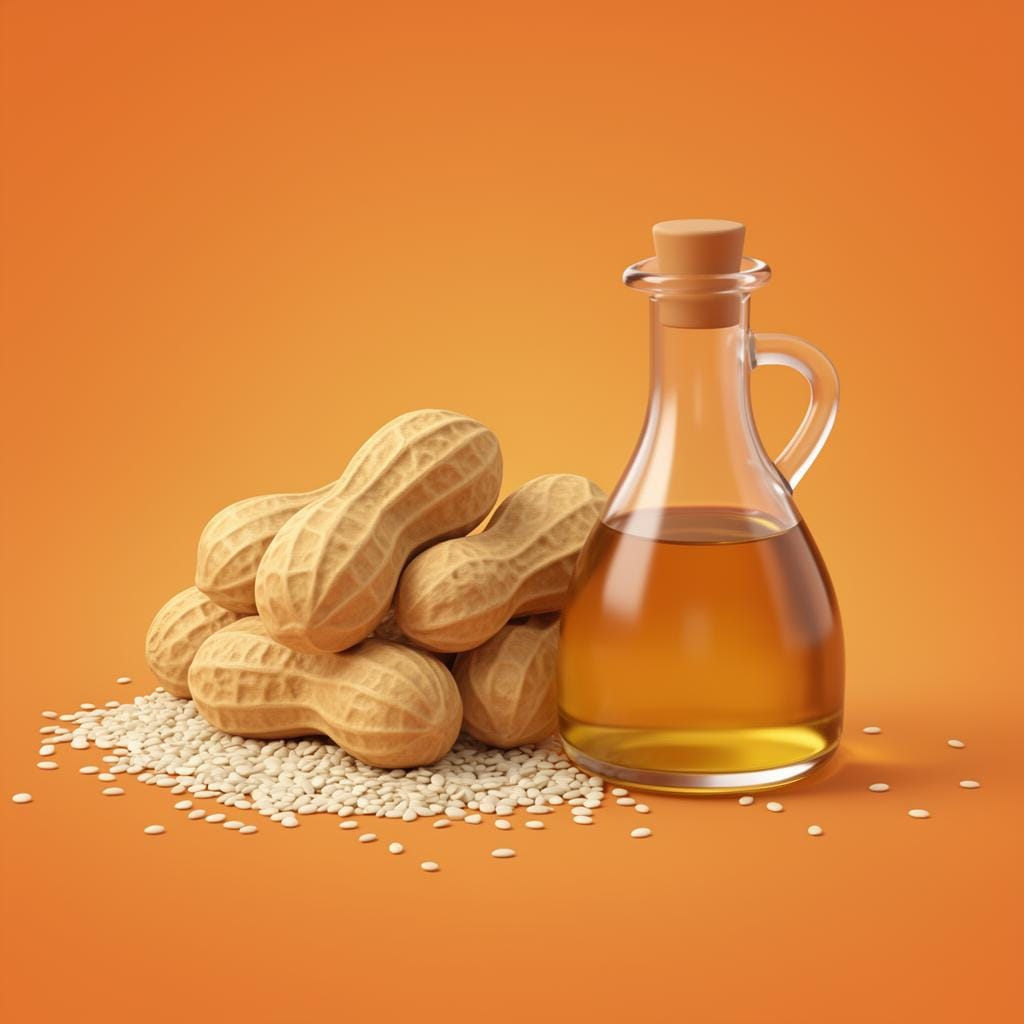
Peanuts can also be processed to produce edible peanut oil, commonly known as groundnut oil.
In oil production, peanut kernels are prepared and subjected to an oil-extraction process. Depending on the plant and production method, the oil may then undergo filtration and other refining or finishing processes before being packaged for its intended market.
Peanut oil is primarily used as an edible cooking oil and can also have applications in food manufacturing.
One important advantage of oil processing is that it creates more than one potential product. Along with the extracted oil, the remaining solid material can become peanut cake or peanut meal, depending on the process and intended use.
If you’re interested in the plant side of oil production, explore Swastik Technology’s Mini Oil Mill solutions.
4. Blanched Peanuts
Blanched peanuts are peanut kernels from which the reddish-brown skin has been removed.
Blanching is particularly useful when manufacturers want a clean, uniform-looking kernel for further processing.
Blanched peanuts are commonly used in:
- Peanut butter
- Confectionery
- Bakery products
- Snack foods
- Peanut-based ingredients
- Food manufacturing
The kernels may be sold whole, split, sliced, or further processed depending on the customer’s requirements.
Blanching and sorting also form part of quality-control strategies in peanut processing. Food-safety guidance emphasizes appropriate sorting and handling because peanuts can be susceptible to aflatoxin contamination.
5. Peanut Flour
Peanut flour is produced by grinding peanut material into a fine flour or powder.
The exact characteristics depend on the raw material and processing method. Peanut flour can be produced from roasted peanuts or from material remaining after oil extraction, with the latter often having a lower fat content.
Peanut flour can be used in:
- Bakery products
- Biscuits and cookies
- Protein-rich food formulations
- Smoothies and beverages
- Sauces
- Snacks
- Food mixes
For manufacturers, peanut flour is an example of how peanuts can be converted into an ingredient rather than simply sold as a whole-kernel snack.
6. Peanut Powder
Peanut powder is another form of processed peanut ingredient.
It can be produced by grinding suitable peanut material into a fine consistency. Depending on the manufacturing process, the product can be formulated for use in beverages, bakery products, snacks, desserts, and other food applications.
The terms peanut flour and peanut powder are sometimes used interchangeably in commercial contexts, but they can refer to products with different specifications, fat levels, particle sizes, and intended applications.
Therefore, manufacturers should define the required product specification before selecting the processing route.
7. Peanut Snacks
Peanuts are also used to create a wide range of ready-to-eat snack products.
Instead of simply selling plain roasted peanuts, manufacturers can add flavors, coatings, spices, or other ingredients to create differentiated products.
Examples include:
- Spiced peanuts
- Masala peanuts
- Coated peanuts
- Crunchy peanut snacks
- Peanut snack mixes
- Peanut bars
- Seasoned roasted peanuts
This category can offer businesses an opportunity to move from selling a commodity ingredient to selling a packaged consumer product.
8. Peanut Confectionery Products
Peanuts are widely used as an ingredient in confectionery. They can be incorporated into products such as:
- Peanut brittle
- Peanut candy
- Peanut bars
- Chocolate-coated peanuts
- Caramelized peanut products
- Peanut-based sweets
- Nut-and-peanut confectionery
In these applications, peanuts may be used whole, chopped, split, roasted, or ground depending on the desired texture and formulation.
This is another example of value addition: instead of selling raw or minimally processed peanuts, manufacturers can combine them with other ingredients to create finished consumer products.
9. Peanut Protein and Food Ingredients
Peanuts can also serve as a source of ingredients for food formulations.
Depending on the processing method, manufacturers can produce peanut-derived ingredients with different fat, protein, particle-size, flavor, and functional characteristics.
These ingredients can be incorporated into:
- Bakery products
- Nutrition-focused foods
- Snack formulations
- Protein-rich food products
- Food mixes
- Confectionery
The exact nutritional and functional properties depend heavily on the raw material and processing method, so product specifications should be established before production.
10. Peanut Cake
Peanut cake is an important byproduct associated with peanut oil extraction.
When oil is removed from peanut kernels, the remaining solid material can be collected and processed into peanut cake or related oilseed byproducts.
Its value depends on factors such as:
- The oil extraction method
- Residual oil content
- Protein content
- Moisture
- Quality of the original peanuts
- Intended market
Peanut cake may have applications in animal-feed formulations, subject to appropriate quality and safety requirements.
This illustrates an important principle of peanut processing: the objective is not always to produce only one product. A well-planned operation can generate a primary product alongside commercially useful byproducts.
11. Peanut Meal
Peanut meal is another peanut-derived material associated with oil extraction.
Compared with whole peanuts, peanut meal can have a different nutritional composition because much of the oil has been removed.
It can be used as an ingredient in animal-feed applications where it meets the relevant quality and safety requirements.
However, peanut-derived feed materials require proper quality control. Peanuts and peanut byproducts can be vulnerable to aflatoxin contamination, so sourcing, sorting, drying, storage, testing, and traceability are important considerations. International food-safety guidance specifically emphasizes controlling moisture, storage conditions, sorting, and contamination risks in peanuts and their byproducts.
12. Peanut Shells and Their Uses
Not every useful product comes from the peanut kernel.
Peanut shells are generated when peanuts are shelled, and depending on local requirements and processing economics, they can have uses beyond being treated simply as waste.
Potential applications include:
- Biomass
- Fuel applications
- Agricultural uses
- Industrial materials
- Composting and soil-related applications
- Other value-added uses
The suitability of peanut shells for a particular application depends on their cleanliness, moisture, local regulations, processing requirements, and market demand.
This is why efficient peanut processing is not only about maximizing kernel recovery. It can also involve finding useful applications for the materials generated alongside the main product.
How One Peanut Crop Can Become Many Different Products
One of the biggest advantages of peanuts is their versatility. A simplified product map looks like this:
Raw Peanuts → Cleaning, Sorting & Preparation → Peanut Kernels → Different Processing Routes:
- Roasting → Roasted Peanuts → Snacks
- Grinding → Peanut Butter → Food Products
- Oil Extraction → Peanut Oil + Peanut Cake/Meal
- Milling → Peanut Flour / Peanut Powder
- Blanching → Blanched Peanuts → Bakery / Confectionery / Snacks
- Further Processing → Peanut Bars, Sweets, Coated Peanuts & Other Products
This is why the same agricultural crop can serve completely different markets.
Which Peanut Products Offer the Most Value?
There is no single answer because profitability depends on raw peanut prices, product quality, processing costs, market demand, packaging, branding, scale, and the selling price of the finished product.
However, there is a useful distinction between commodity products and value-added products.
Commodity-oriented products
- Raw peanut kernels
- Shelled peanuts
- Peanut oil
- Peanut cake
- Peanut meal
These products can be produced at scale and may have established markets, but competition and commodity pricing can strongly influence margins.
Value-added products
- Branded peanut butter
- Flavored roasted peanuts
- Peanut snacks
- Peanut confectionery
- Specialty peanut flour
- Premium packaged peanut products
These products can offer more opportunities for differentiation through quality, formulation, packaging, branding, and distribution.
For a business considering a peanut processing operation, the right product should therefore be selected based on available raw material, target customers, production capacity, investment level, and market demand — rather than simply choosing the product with the highest theoretical selling price.
What Does a Peanut Processing Plant Have to Do With These Products?
The finished product may be different, but the foundation begins with properly prepared raw peanuts.
A commercial peanut processing setup typically needs to handle activities such as cleaning, shelling, separation, sorting, and grading before kernels are directed toward their specific end use. Swastik Technology’s peanut processing plant, for example, is designed around these core stages, including cleaning, shelling, separation, sorting, and grading.
Learn more about the Peanut Processing Plant and how commercial processing systems are structured.
For businesses that primarily need to prepare raw peanuts before further processing, a Peanut Cleaning Plant can provide the initial cleaning, sorting, de-stoning, and storage-related stages.
The specific equipment required depends on the intended final product, capacity, raw-material characteristics, and required quality specifications.
Why Product Selection Matters Before Setting Up a Peanut Processing Business
Choosing the final product first can make the rest of the project much easier to plan.
For example, a business producing Roasted Peanuts will have different processing, roasting, seasoning, packaging, and quality requirements from a business producing Peanut Oil. Likewise, a peanut butter manufacturer will have different requirements from a processor selling graded raw kernels to food manufacturers.
Before investing in equipment, businesses should consider:
- What product do you want to manufacture?
- Who will buy the finished product?
- What quality specification does the market require?
- What raw peanut varieties and grades are available?
- What production capacity is appropriate?
- What level of automation is required?
- What packaging format will be used?
- What quality and food-safety controls are necessary?
- What will happen to processing byproducts?
- What markets will you sell into?
These questions help determine whether a business needs a cleaning plant, processing line, oil mill, roasting system, or a more specialized combination of equipment.
Quality and Safety Matter Across Every Peanut Product
Whatever the final product, quality starts with the raw peanuts.
Peanuts require careful handling because moisture, temperature, storage conditions, insects, mould, and other factors can affect quality. Aflatoxin is a particularly important food-safety concern associated with peanuts, which is why international guidance emphasizes appropriate harvesting, drying, sorting, storage, sampling, and monitoring practices.
For processors, this means that producing a good finished product is not simply about having the right processing machinery. It also requires:
- Good-quality raw material
- Proper cleaning and sorting
- Appropriate moisture management
- Hygienic handling
- Suitable storage
- Quality testing
- Traceability
- Appropriate packaging
A strong processing system combines raw-material quality + suitable processing + quality control + proper storage.
Final Thoughts
Peanuts can be transformed into far more than a simple snack.
From roasted peanuts and blanched kernels to peanut butter, peanut oil, flour, snacks, confectionery, peanut meal, and other value-added products, the crop offers multiple opportunities for food processors and agricultural businesses.
The best product depends on the market you want to serve. A processor targeting retail consumers may focus on branded roasted peanuts, peanut butter, or snacks. An industrial processor may focus on kernels, peanut oil, flour, or other ingredients. Oil extraction can also create valuable byproducts such as peanut cake or meal.
The key is to start with the finished product and target market, then work backward to determine the appropriate raw material, processing method, machinery, capacity, and quality requirements.
For businesses looking to move from raw peanuts to commercial-scale production, Swastik Technology provides solutions for peanut processing and cleaning applications, with equipment and plant configurations designed around different processing requirements.
In short: peanuts are not just one product — they are a raw material from which an entire range of food, ingredient, oil, feed, and value-added products can be created.
FAQ
What products can you make from peanuts?
Common products include roasted peanuts, blanched peanuts, peanut butter, peanut oil, peanut flour, peanut powder, snacks, confectionery, peanut cake, and peanut meal.
What is the most common product made from peanuts?
Peanuts are commonly consumed as whole or roasted kernels, but they are also widely processed into products such as peanut oil and peanut butter.
Can peanuts be used to make oil?
Yes. Peanut kernels can be processed to extract edible peanut oil. The remaining solid material can also become peanut cake or meal, depending on the extraction process.
What can peanut shells be used for?
Peanut shells can have applications such as biomass, fuel, agricultural uses, and other industrial applications, depending on their characteristics and local market requirements.
What are value-added peanut products?
Value-added peanut products are products created by processing peanuts into higher-value consumer or industrial goods, such as peanut butter, flavored roasted peanuts, peanut snacks, confectionery, flour, and specialty ingredients.
Is peanut processing a good business opportunity?
Peanut processing can offer opportunities because one raw material can serve multiple markets. However, profitability depends on raw-material costs, processing efficiency, product positioning, market demand, quality, packaging, and operating costs.
What machinery is required for peanut processing?
The machinery depends on the final product. A commercial peanut operation may require equipment for cleaning, shelling, separation, grading, sorting, drying, and material handling, followed by product-specific equipment such as roasting, grinding, oil extraction, or packaging systems. Swastik Technology provides a range of peanut processing machinery, including graders, pre-cleaners, decorticators, destoners, elevators, and related equipment.