
Setting up a peanut processing plant in India can be a profitable opportunity for entrepreneurs looking to enter the food-processing and agricultural sector. India has a strong peanut production base, established domestic demand, and opportunities to supply processed peanuts to food manufacturers, wholesalers, retailers, and export markets.
However, one of the first questions any investor asks is: How much does a peanut processing plant cost in India?
The answer depends on several factors, including plant capacity, level of automation, machinery configuration, building and infrastructure requirements, and the type of peanut products you plan to produce.
A small semi-automatic unit may require a relatively modest investment, while a fully automatic commercial-scale processing plant can require a significantly larger budget.
In this guide, we break down the major costs involved in setting up a peanut processing plant in India — drawing on our 35+ years of experience designing and installing processing plants for 700+ customers across India and export markets.
What Is the Cost of a Peanut Processing Plant in India?
The cost of a peanut processing plant depends primarily on its production capacity and degree of automation.
As a broad planning range:
| Plant Type | Typical Capacity | Approximate Machinery Investment* |
| Small / Semi-Automatic | 500 kg–1 ton/hour | ₹15 lakh–₹35 lakh+ |
| Medium / Automatic | 1–2 tons/hour | ₹30 lakh–₹60 lakh+ |
| Large / Fully Automatic | 3–5+ tons/hour | ₹60 lakh–₹1.5 crore+ |
*These are indicative planning ranges, not fixed quotations. Actual prices vary according to machinery configuration, automation, equipment specifications, material of construction, installation requirements, and supplier.
It is also important to understand that machinery cost is not the same as total project cost.
A complete peanut processing plant may also require land, building, electrical installation, storage, material-handling equipment, packaging systems, utilities, labour, licenses, and working capital.
Therefore, the total investment can be considerably higher than the machinery quotation alone.
What Determines Peanut Processing Plant Cost?
There is no single price for a peanut processing plant. Several factors can change the investment significantly.
1. Plant Capacity
Capacity is one of the biggest cost factors.
A plant processing 500 kg of peanuts per hour will naturally require less machinery and infrastructure than a facility designed to process 5 tons per hour.
Higher-capacity plants generally require:
- Larger processing machines
- Larger conveyors and elevators
- Bigger cleaning and grading systems
- Higher electrical capacity
- More storage space
- Larger buildings
- More material-handling equipment
Therefore, the first decision should be determining your required production capacity.
2. Level of Automation
The plant can be designed as:
- Manual
- Semi-automatic
- Fully automatic
A semi-automatic plant generally requires more manual labour but can have a lower initial machinery investment.
A fully automatic plant typically requires a higher initial investment but can provide better production consistency, reduced labour dependency, and easier large-scale operation.
3. Machinery Configuration
Not every peanut processing business requires the same machinery.
For example, a basic peanut cleaning and grading operation will have a different machinery requirement from a complete processing line that includes:
Cleaning → Destoning → Grading → Shelling → Separation → Sorting → Packaging
Additional processes such as roasting, blanching, skin removal, splitting, or oil extraction will further increase the machinery investment.
4. Product You Want to Sell
The final product also affects plant cost.
A business producing:
- Raw cleaned peanuts
- Graded peanuts
- Shelled peanuts
- Blanched peanuts
- Roasted peanuts
- Peanut kernels
- Peanut butter
- Peanut oil
will require different equipment and processing configurations.
For this reason, the plant should be designed according to the intended product range rather than simply choosing machines based on their individual prices.
Peanut Processing Machinery Required
A typical peanut processing plant can contain several machines, depending on the required process.
1. Peanut Cleaning Machine
Raw peanuts usually contain dust, stones, leaves, soil, and other foreign materials.
A cleaning machine removes unwanted impurities before further processing.
This is one of the basic machines required in most peanut processing plants.
2. Destoner
A destoner separates heavier materials such as stones from peanuts, and a magnetic destoner can additionally remove iron and ferrous particles.
This helps protect downstream machinery and improves the quality of the processed product.
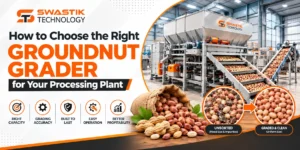
3. Peanut Grading Machine
Peanuts can be separated according to size using a grading system such as a screen grader or round grader.
Uniform grading is particularly useful when selling peanuts to food processors, retailers, exporters, and other buyers who require specific kernel sizes.
4. Peanut Shelling Machine
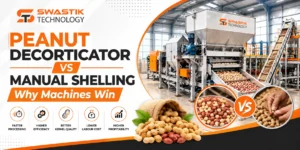
If the plant processes unshelled peanuts, a peanut decorticator can be used to separate the shells from the kernels.
The shelling system should be selected according to:
- Required capacity
- Peanut variety
- Kernel size
- Desired shelling efficiency
- Acceptable kernel breakage
5. Peanut Kernel Separator
After shelling, the mixture may contain kernels, partially shelled peanuts, and shells.
A gravity separator separates these materials by weight to improve processing efficiency and product quality.
6. Peanut Sorting Machine
Modern plants may use optical or colour sorting systems to identify and remove defective, discoloured, damaged, or unwanted kernels.
This can be particularly valuable for premium-quality and export-oriented production. Browse our full machinery range →
7. Conveyors and Material Handling Equipment
Conveyors, bucket elevators, screw conveyors, hoppers, and other material-handling systems connect different stages of the plant.
They reduce manual handling and help maintain a continuous production flow.
8. Peanut Packaging Machine
Once processing is complete, the peanuts need to be packed according to the target market.
Packaging requirements may differ for:
- Retail packs
- Bulk bags
- Export packaging
- Food-industry supply
- Wholesale distribution
A packaging machine can therefore be integrated according to the required output — ask our team about packaging options for your specific project.
Peanut Processing Plant Machinery Cost Breakdown
Instead of looking only at the total machinery price, it is useful to divide the investment into different equipment categories.
| Equipment Category | Cost Impact |
| Cleaning system | Low–Medium |
| Destoning system | Low–Medium |
| Grading system | Medium |
| Shelling system | Medium–High |
| Separation system | Medium |
| Sorting system | Medium–High |
| Conveyors & elevators | Medium |
| Packaging system | Medium–High |
| Electrical & control system | Medium |
| Installation & commissioning | Additional |
The actual price depends heavily on the capacity and configuration selected.
For example, adding an advanced sorting machine and automatic packaging line can substantially increase the overall investment compared with a basic cleaning, shelling, and grading plant.
Land and Building Cost
Machinery is only one part of the project.
You also need suitable space for:
- Raw peanut storage
- Processing machinery
- Finished product storage
- Packaging
- Loading and unloading
- Office and staff facilities
- Utility systems
- Internal movement of materials
The required land area depends on plant capacity and layout.
A larger facility may require more space not only for machines but also for inventory.
This is particularly important because peanuts are generally purchased in batches, while processed products may be dispatched according to customer orders.
If you already own suitable industrial premises, your initial project investment can be significantly lower.
Electrical Installation Cost
Peanut processing machinery requires an appropriate electrical supply.
The electrical budget may include:
- Main electrical panel
- Cabling
- Control panels
- Motors
- Starters or drives
- Distribution systems
- Lighting
- Safety systems
- Generator or backup power, if required
The final requirement depends on the machinery selected and total connected load.
A plant should therefore have its electrical system designed around the actual machinery configuration instead of using a generic estimate. Our engineering team can help plan this as part of your project layout.
Installation and Commissioning Cost
Buying machines is not the final step.
The equipment must be:
- Transported to the plant
- Positioned correctly
- Installed
- Electrically connected
- Aligned
- Tested
- Commissioned
Some manufacturers include installation and commissioning in their quotation, while others charge these costs separately. At Swastik Technology, we guide clients through the entire installation process — from equipment layout to on-site commissioning.
Always clarify this before comparing quotations from different suppliers.
Labour Cost
Labour requirements depend on the automation level.
A highly automated plant can reduce manual intervention, whereas a semi-automatic plant may require more operators.
Your labour plan may include:
- Machine operators
- Supervisors
- Quality-control staff
- Maintenance personnel
- Packaging workers
- Loading and unloading workers
- Administrative staff
Labour should be considered as an operating expense, rather than a one-time plant setup cost.
Working Capital Requirement
One of the most overlooked costs when starting a peanut processing business is working capital.
You need money to purchase raw peanuts before you receive payment from customers.
Working capital may be required for:
- Raw peanuts
- Packaging materials
- Electricity
- Salaries
- Transportation
- Maintenance
- Inventory
- Customer credit periods
- Other operating expenses
For a commercial plant, the amount invested in raw material inventory can become a significant part of the total business requirement.
Peanut Processing Plant Cost by Capacity
Capacity-based planning is one of the easiest ways to understand the potential investment.
500 kg–1 Ton Per Hour Plant
This can be suitable for entrepreneurs starting with a smaller production target.
A smaller plant can reduce the initial machinery and infrastructure requirement, although the cost per unit of production may be higher compared with a large-scale facility.
1–2 Tons Per Hour Plant
This capacity can be considered for businesses targeting a more established commercial operation.
The plant may include automated cleaning, grading, shelling, separation, sorting, and material-handling systems depending on the required product quality.
3–5+ Tons Per Hour Plant
Large-scale plants require substantially greater investment.
They may include:
- High-capacity cleaning systems
- Automated shelling
- Advanced grading
- Optical sorting
- Automated material handling
- Large storage facilities
- Automatic packaging
- Advanced control systems
Such plants are generally designed for larger domestic or export-oriented operations — including businesses supplying to markets such as South Africa, Indonesia, Saudi Arabia, and the UK.
| Get a project cost & profitability estimate customized to your capacity. Contact Swastik Technology → |
Example of a Peanut Processing Plant Investment Structure
Suppose an entrepreneur plans to establish a medium-sized peanut processing facility.
The project budget may include:
| Investment Area | Example Cost Category |
| Processing machinery | Major investment |
| Conveyors & material handling | Moderate investment |
| Packaging equipment | Moderate investment |
| Electrical installation | Additional investment |
| Building & civil work | Major investment |
| Storage facilities | Moderate investment |
| Installation & commissioning | Additional investment |
| Licenses & compliance | Additional investment |
| Working capital | Major ongoing requirement |
This illustrates why asking only “What is the price of a peanut processing machine?” is not enough.
A proper project estimate should calculate the complete cost of establishing and operating the facility.
How to Reduce Peanut Processing Plant Cost
Reducing investment does not necessarily mean buying the cheapest machinery.
Instead, focus on designing the plant efficiently.
Choose the Right Capacity
Do not install a 5-ton-per-hour plant if your current market can only absorb 1 ton per hour.
At the same time, avoid selecting a very small plant if you already have strong demand.
Select Automation Carefully
Automation should be based on your production volume, labour availability, product quality requirements, and long-term business plan.
Plan the Layout Properly
A well-designed layout can reduce:
- Material movement
- Labour requirements
- Conveyor length
- Handling losses
- Installation complexity
Purchase a Complete Processing Line
Buying compatible machines from a single plant supplier can sometimes simplify:
- Equipment integration
- Installation
- Commissioning
- Training
- After-sales support
This is one advantage of working with a single manufacturer like Swastik Technology — our machines are designed to work together as one integrated line, rather than being sourced from multiple vendors.
Consider Future Expansion
If you expect production to increase, design the plant layout with future expansion in mind.
This can prevent expensive modifications later.
What Should You Ask a Peanut Processing Plant Manufacturer?
Before purchasing machinery, ask the manufacturer for a detailed quotation covering:
- Plant capacity
- Machine specifications
- Production rate
- Power consumption
- Material of construction
- Automation level
- Installation charges
- Transportation
- Warranty
- Spare parts
- Training
- After-sales service
- Expected recovery
- Shelling efficiency
- Sorting efficiency
- Delivery timeline
Most importantly, ask whether the quoted price includes the complete processing line or only individual machines.
Two suppliers may quote very different prices because their quotations include different equipment.
Is a Peanut Processing Plant Profitable in India?
A peanut processing plant can be profitable when the business has efficient procurement, good processing recovery, consistent quality, and reliable sales channels.
Profitability depends on factors such as:
- Raw peanut purchase price
- Processed peanut selling price
- Kernel recovery
- Product quality
- Production capacity
- Labour cost
- Electricity consumption
- Packaging cost
- Transportation
- Market demand
- By-product utilization
Rather than calculating profitability from the selling price alone, investors should prepare a detailed project report covering both capital expenditure and operating expenditure.
Frequently Asked Questions
What is the minimum investment for a peanut processing plant in India?
A small semi-automatic unit processing 500 kg–1 ton per hour can start from approximately ₹15 lakh–₹35 lakh for machinery alone, excluding land, building, and working capital.
Is a peanut processing business profitable in India?
Yes, when the business has efficient raw material procurement, good processing recovery, consistent product quality, and reliable buyers. Profitability depends on more than machinery cost — it depends on operating efficiency and market demand.
How much land is required for a peanut processing plant?
Land requirement depends on plant capacity and layout — larger plants need more space for machinery, raw material storage, and finished product storage. There’s no fixed figure; it should be planned based on your specific configuration.
Does the machinery price include installation?
This varies by manufacturer. Some include installation and commissioning in their quotation, while others charge separately — always confirm this before comparing quotes.
Can I expand my peanut processing plant later?
Yes, if the plant layout is designed with future expansion in mind from the start. This is easier and less expensive than retrofitting a plant that wasn’t planned for scale-up.
Final Thoughts on Peanut Processing Plant Cost in India
The cost of a peanut processing plant in India can vary widely because there is no standard plant configuration for every business.
A small semi-automatic unit may require a comparatively lower investment, while a fully automatic high-capacity processing facility can require an investment of ₹1 crore or more when machinery and supporting infrastructure are considered.
The right investment depends on your:
- Required production capacity
- Target market
- Product range
- Automation level
- Available infrastructure
- Budget
- Expansion plans
Therefore, instead of choosing a plant solely on the basis of its quoted price, evaluate the complete processing line, production capacity, efficiency, quality, operating cost, and after-sales support.
If you are planning to establish a peanut processing plant, the best approach is to first determine your required capacity and product requirements and then obtain a customized machinery quotation based on your project.
Why Choose Swastik Technology?
Swastik Technology has been manufacturing peanut and groundnut processing machinery in Rajkot, Gujarat for 35+ years, serving 700+ customers across India and export markets including South Africa, Indonesia, Saudi Arabia, and the UK. We’re IEC-certified and Udyam-registered, and our equipment covers the complete processing line — cleaning, destoning, grading, shelling, separation, and material handling.